My exploration begins at the intersection of the digital and the physical. The ambiguity about my personal position made me a little entangled and painful, so I thought of taking a look in the middle. I started thinking: Why is there this change? Where do we draw the line between physical and digital media?
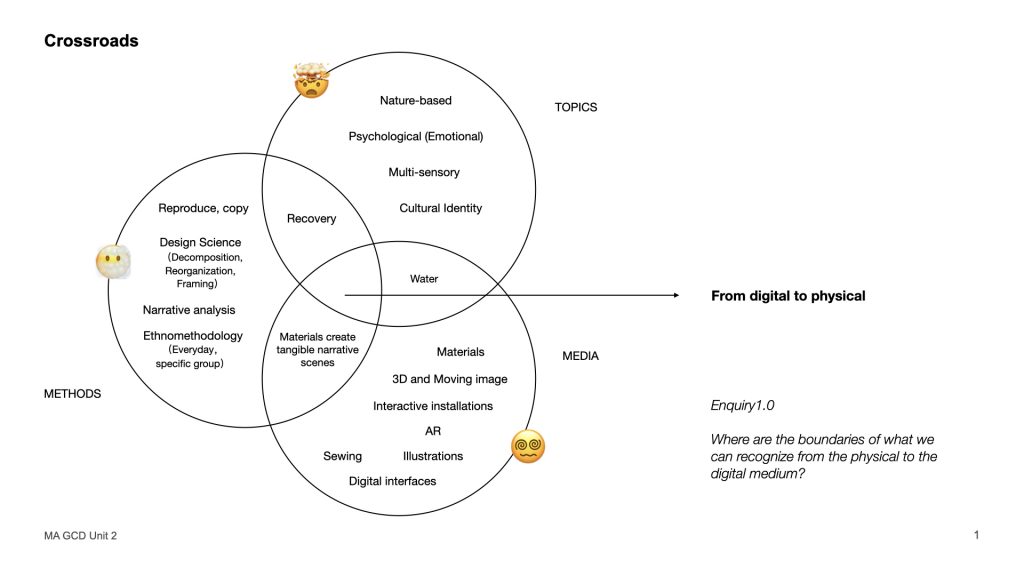
Manovich’s notion of digital materiality and McLuhan’s theory that media is an extension of human capabilities inspired me to start thinking about whether digital alterations can be recognised when they are seamlessly inserted into the physical environment. The first unit of work all unfolded in my everyday life, so I still chose to start there; if only rubbish could just be deleted, could spinning empty the plates?

My 100 iterations reflected digital manipulation with commands such as “delete”, “pixelate” or “add” on my everyday photographs, to which I added manual annotations at the end, blurring the boundaries even further. I added manual annotations at the end to blur the lines even further.


You can flip through the top image (unprocessed image) and then the bottom image (digitally processed photo) to see how you can really recognise him with all this digital processing hidden in your life. I want to invite the audience to experience a kind of boundary blurring and cognitive dissonance through this juxtaposition.
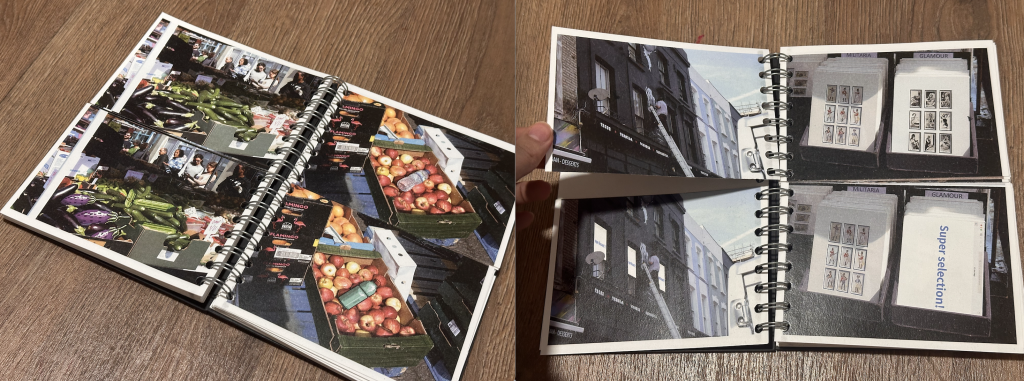
As I alter the image, I am struck by how seamlessly the digital modifications are integrated into the physical representation. I realize that nothing in digital media is inherently verifiable.Change is not only easy, but imperceptible. I began to question: what is authenticity in the digital age? Can digital expression convey the truth? Are we still ourselves when oranges are no longer just oranges? This exploration led me to reflect on how these digital features affect the way we perceive ourselves and others. How does the digitally curated and manipulated “self” affect our understanding of identity when it bears little resemblance to our real-world selves? In addition, the cognitive dissonance that emerged from the iterative experiments caught my attention. I found that digital norms also seem to reshape our bodily experience, for example, when I subconsciously put two fingers on the paper during a misspelling. It was also influencing my behaviour as I manipulated it. I began to think about how our behaviour changes when digital tools that provide instant gratification are removed.

In the second phase, I systematically photographed everyday objects and scenes to capture their essence in their purest physical form – these are the objects that we interact with on a daily basis but are often overlooked. After photographing these objects, I displayed these images on a digital monitor, embedded in its original setup. This setup aims to create a visual loop where the digital and physical not only co-exist but merge.
Do shadows cast by digital light have the same meaning as shadows cast by physical light?
This setup allows for direct interaction between the digital representation and its physical counterpart, emphasising the dual existence of the object as a tangible entity and a digital mimic. The display, although a digital device, has a task that goes beyond its inherently digital nature – to become a window on a replicated physical reality.

When digital images closely reflect the physical environment, perhaps digital replicas can effectively replace our perceived physical reality under certain conditions. I hope that this blurring of boundaries provokes observations of how digital media can alter our perception of the tangible world, causing us to question what is real and what is digitally constructed.
